Always cold. Nothing wrong.
A founder told me, almost apologetically, that he was always cold. Not in winter. Not after swimming. All the time. His feet were cold in bed. His hands were cold in meetings.
A founder told me, almost apologetically, that he was always cold.
Not in winter. Not after swimming. All the time. His feet were cold in bed. His hands were cold in meetings. His lower back felt like someone had laid a cool cloth across it. He wore socks to sleep and still woke with cold feet. His wife, lying next to him, was warm.
He had mentioned it to his doctor. Thyroid was checked. TSH came back at 3.1. In range. File closed.
He mentioned it again a year later. Same test, same result, same conversation. He stopped mentioning it. He bought thicker socks and assumed this was what forty-seven felt like.
It is not what forty-seven feels like. It is what a specific pattern looks like, and it is one of the most readable things in the body if someone is willing to look past the thyroid panel.
What this gives you
A way to understand why you are cold when nothing is wrong on paper, what the cold is actually telling you, and what starts to shift it. If you have cold feet in bed, cold hands at your desk, and a doctor who has run out of things to check, this is the piece that explains the gap.
Why the panel misses it
Your doctor checked the right thing. Thyroid governs metabolic rate, and metabolic rate governs heat production. If the thyroid is failing, you get cold. That logic is correct.
But TSH at 3.1 is not the same finding as TSH at 1.2. Both are in range. Both pass the screen. One is a thyroid running at the top of its capacity. The other is a thyroid sitting near the floor of what is considered acceptable, producing enough hormone to avoid a diagnosis but not enough to keep you warm.
This is the "normal versus optimal" problem that runs through everything I write. The range is a fence around disease. It was never a description of where you function well. A man with TSH at 3.1, cold extremities, a sluggish morning, and a resting heart rate that has quietly dropped over the past two years is not hypothyroid. He is also not running properly. The gap between those two words is where he lives, and nobody is looking at it.
And even when the thyroid is genuinely optimal, the cold can still be there, because the thyroid is not the only thing that produces warmth.
Where the warmth actually comes from
This is the part your doctor was never trained to read, and it is the part the tradition I trained in has mapped for a very long time.
You have a deep warmth in you. Not body temperature. Not metabolism in the textbook sense. A warmth that sits low, in the core and the lower body, and radiates outward and upward. It heats the extremities. It powers digestion. It drives the hormones. It is the engine underneath the engine.
When it is strong, you are warm. Your feet are warm in bed. Your hands are warm in a cold room. Your digestion runs without effort. Your recovery is fast. Your drive is present without forcing. You do not think about any of this because it works in the background, the way a furnace heats a house without anyone standing next to it.
When it weakens, the warmth withdraws from the periphery first. The feet go cold. Then the hands. Then the lower back. The digestion slows and loosens. Recovery takes longer. Drive drops. And something specific happens that explains a symptom most founders carry without connecting it to the cold.
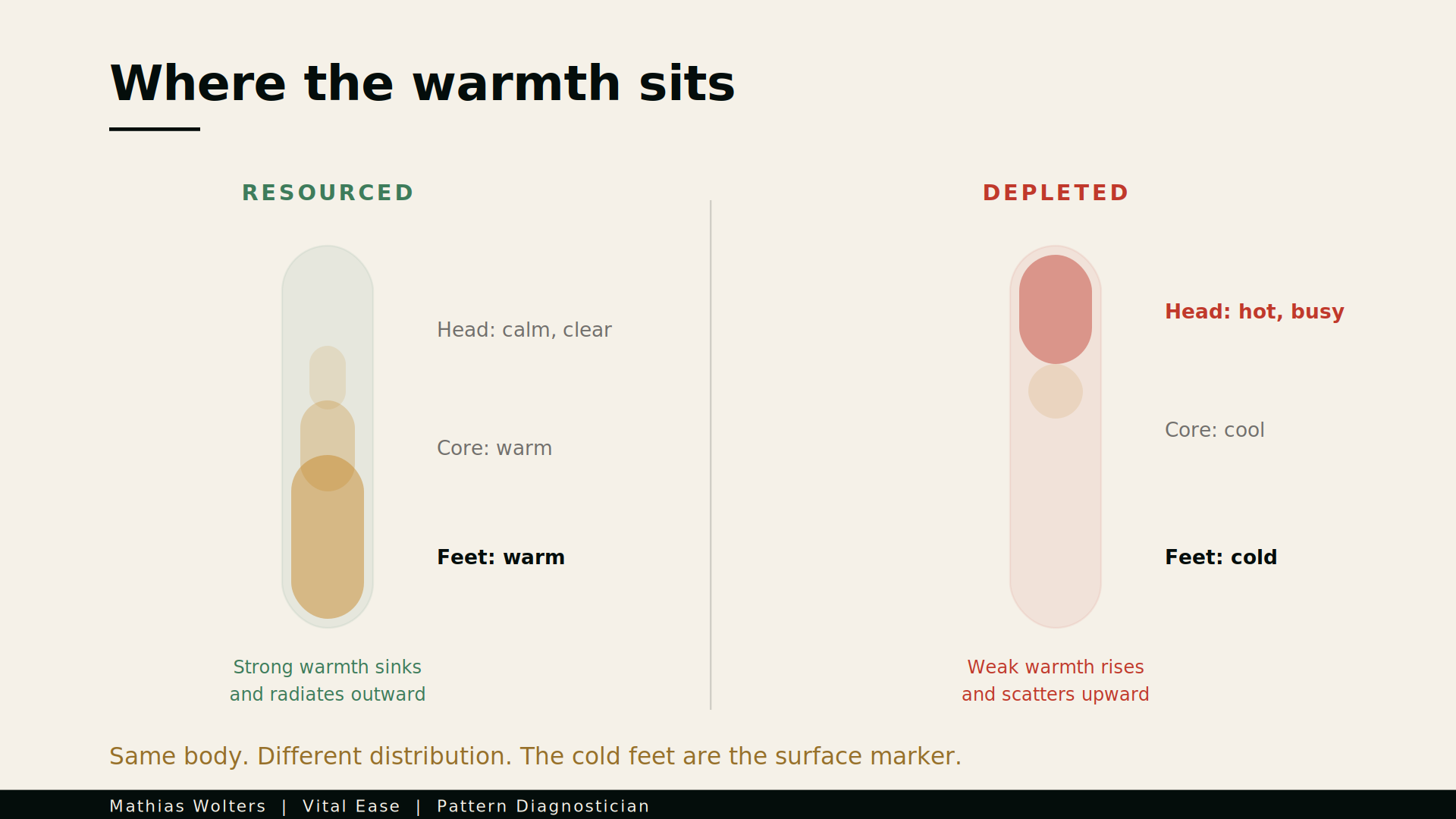
The warmth that should sit low gets pushed upward. Not because it is strong. Because it is weak. Strong warmth sinks and radiates. Weak warmth rises and scatters. It goes to the head and stays there. The head runs hot and busy while the body below runs cold and slow.
Hot head, cold feet. Busy mind, flat body. Wired above, depleted below. That is not two symptoms. It is one pattern, and the cold feet are the most reliable surface marker of it.
The self-check you can do tonight
Lie down in bed before sleep. Put one hand on your lower belly, below the navel. Put the other on your forehead.
Which one is warmer.
If the forehead is warm and the belly is cool, the warmth is sitting in the wrong place. It has been driven up. The lower body, where the deep engine lives, is not being heated from below. The head is catching what should have been distributed downward.
Now check the feet. Not whether they feel cold to you. Whether they are cold to the touch. A warm foot and a cold foot carry different information, and both of them are accurate.
If the belly is cool, the feet are cold, and the head is warm, you have the pattern. Nothing is broken. The distribution has shifted, and it shifted for reasons that are identifiable and reversible.
Why it shifted
Three things, and they will sound familiar because they are the same three that sit underneath most of what I write.
Years of sustained pressure. Cortisol, the stress hormone, drives warmth upward and outward. It is a mobilisation signal. It sends blood to the brain and the muscles and pulls it away from the core and the periphery. In a short burst, that is useful. Over years, it becomes the default distribution. The system forgets how to send the warmth back down because the signal to mobilise never switched off.
The conversion engine weakening. The warmth in your lower body is generated, in part, by the transformation of food into usable energy. When that engine weakens, less warmth is produced from below. The input is the same but the output has dropped. This is why the cold gets worse in founders who eat clean but eat cold, eat irregularly, or eat under stress. The engine that turns food into warmth is not running at capacity.
The deep reserve running down. Underneath the daily engine sits the deep reserve that powers the hormones, the neural drive, and the root warmth itself. It depletes with age, with overwork, with illness. When it drops far enough, the warmth it used to radiate simply is not there anymore. The socks get thicker. The room gets warmer. The body stays cold, because the heat source is not external.
What starts to shift it
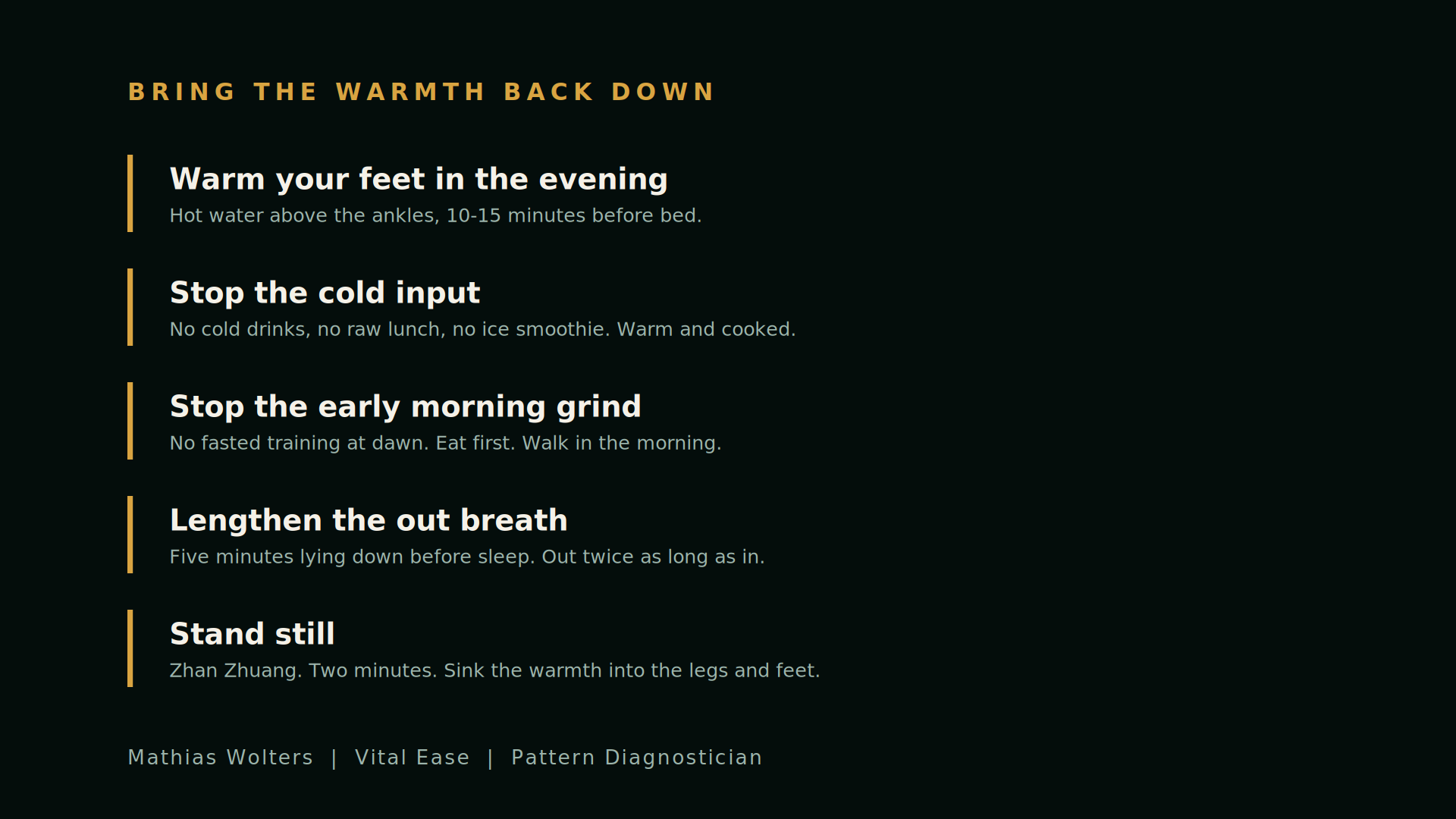
The direction is: bring the warmth back down and stop driving it up.
Warm your feet in the evening. Hot water, above the ankles, ten to fifteen minutes before bed. Then dry socks and stay warm. This is not a hack. It is a direct thermal input to the area that has lost heat, and it draws circulation downward rather than leaving it in the head. Most people sleep differently within the first three nights. That is information.
Stop the cold input. No cold drinks with meals. No raw salad for lunch. No smoothie with ice for breakfast. Everything that enters the system cold has to be warmed before it can be processed, and a weak engine does not have the spare capacity. Warm, cooked food at regular times, especially at lunch. This is the same lever from every edition of this newsletter, and it matters here more than anywhere else because you are asking the engine to produce warmth from what you feed it. Feed it cold and the equation does not work.
Stop training in the early morning on an empty stomach. That combination spikes cortisol at its natural peak and reinforces the upward drive. Eat first. Train later in the day if you can. Walk in the morning instead.
Lengthen the out breath in the evening. Five minutes, lying down, before sleep. Long slow exhale, twice the length of the inhale. This shifts the nervous system toward recovery and tells the body the mobilisation is over. The warmth starts to redistribute when the system reads the situation as safe.
Stand still. If you have read the grip strength edition of this newsletter, you have already met Zhan Zhuang. Standing practice. Two minutes to start, building slowly. What it does here is specific: it sinks the awareness and the energy downward, into the legs, into the feet, into the lower body. It is the oldest method I know for reversing the upward drive, and it is the physical form of the whole argument. Bring the warmth down. Stay there. Let the body remember where it is supposed to sit.
When the cold does not shift
If you do all of this for a month and the feet are still cold in bed, the deep reserve has declined to a point where lifestyle inputs cannot reach it. You are warming the periphery temporarily but the source that should be generating heat from inside is not producing enough to hold.
This is where herbs do what socks cannot. Warming the deep engine, supporting the root, and rebuilding the reserve that powers the whole distribution. Not from outside. From underneath. That is clinical work, matched to the pattern, sequenced to what the system can carry.
But the warm food, the evening feet, the standing practice, the end of the cold input. Those are the foundation. Start there, and if the cold lifts and holds, you have your answer. If it lifts and returns, you have a different answer, and that one is worth a proper reading.
Before you close this
Cold feet in bed are not a comfort problem. They are the most reliable surface marker of a pattern that sits underneath the fatigue, the slow recovery, the weight that will not move, and the drive that has gone quiet.
Your panel says nothing is wrong. Your feet say otherwise. Both are telling the truth, and the feet are telling a more complete truth, because they are reading a depth the panel does not reach.
Tonight, hands on belly and forehead. Check the feet. Feel which one is warmer.
That is more diagnostic information than your last blood draw gave you about this particular problem. And it cost you ten seconds.
Mathias
P.S. The Sovereign Biological Audit reads 40 markers across eight biological systems against functional optimums rather than population averages. It finds whether the deep warmth has genuinely declined and what has been pulling it down. That is the read that explains why the socks are not enough. vitalease.co/sovereign-biological-audit
P.P.S. If this landed, I went deeper on the thyroid and metabolic pattern behind it in this video: what your normal bloodwork is actually hiding. https://www.youtube.com/watch?v=N2iWl9XCGiw