Eating clean, still depleted
A founder showed me her supplement shelf. Fifteen bottles. B12, zinc, magnesium, iron, a methylated B-complex, digestive enzymes, betaine HCl for stomach acid, a probiotic, fish oil, vitamin D, and a few more I have forgotten.
A founder showed me her supplement shelf. Fifteen bottles. B12, zinc, magnesium, iron, a methylated B-complex, digestive enzymes, betaine HCl for stomach acid, a probiotic, fish oil, vitamin D, and a few more I have forgotten.
She had been building this stack for two years, guided by a functional medicine practitioner who tested everything. Each addition made sense on paper. Her B12 was low, so B12. Her zinc was low, so zinc. Her ferritin was dropping, so iron. Her digestion was slow, so enzymes. Every gap got a capsule.
She was still flat. Same fatigue, same fog, same heavy feeling after eating that had started the whole search in the first place.
I asked her one question nobody had asked. Why do you think all of these are low at the same time.
Because they are not unrelated deficiencies. Fifteen things do not fail independently in a woman who eats well. They fail together when the system that extracts value from food stops working properly. She did not have fifteen problems. She had one, and it was upstream of all of them.

What this gives you
A way to tell whether you are genuinely deficient or whether your body has lost the ability to convert what you eat into what it needs. The difference matters, because the fix for each one is the opposite of the other. Supplement a true deficiency and it resolves. Supplement a conversion failure and you are pouring grain onto a broken mill. The pile gets bigger. The flour does not.
The engine nobody checks
Here is what is supposed to happen when you eat.
Food arrives. The stomach breaks it down with acid. Bile emulsifies the fats. Enzymes split the proteins and carbohydrates into pieces small enough to absorb. The gut lining pulls the nutrients through into the blood. The body uses them to build, repair, and produce energy.
That chain has a dozen steps, and each one depends on the one before it. Low stomach acid means poor protein breakdown. Poor protein breakdown means amino acids do not arrive. Without amino acids, enzyme production drops. Without enzymes, the next meal breaks down even less efficiently. The system feeds back on itself, and each cycle is a little worse than the last.
The Western model sees each step as its own problem and prescribes for each one separately. Low acid, take betaine. Low enzymes, take enzymes. Low B12, take B12. Low iron, take iron. It is logical, it is evidence-based, and it misses the question entirely.
Why did the engine weaken in the first place.
The founder pattern
The engine weakens for reasons that read like a founder's job description.
Eating at the desk, fast, between calls, barely chewing. Irregular meals, sometimes two, sometimes five, never at the same time. Cold food straight from the fridge, raw salads, smoothies with ice, because someone said clean eating looks like that. Coffee on an empty stomach first thing, then nothing until two. Eating late, nine or ten, then lying down on a full system. And underneath all of it, the one that does the most damage: low-grade worry running constantly, the kind that never spikes into crisis but never switches off.
Every one of those weakens the conversion engine. Not dramatically, not in a week. Slowly, over years, until the system can no longer extract full value from what arrives. The food is good. The diet is clean. The output is poor, because the mill is turning slowly and adding more grain does not speed it up.
This is the most common pattern I see in clinical practice. Not bad food. Not bad habits. A conversion engine that has been ground down by the way founders eat, when they eat, and the state they are in while they eat.
How to tell the difference
True deficiency and conversion failure look the same on a single blood test. B12 is low either way. Iron is low either way. The panel does not tell you which one you have.
But the pattern does.
If one thing is low and everything else is normal, you probably have a true deficiency. A vegan with low B12 is not absorbing it because it is not in the food. Supplement it and it resolves. That is straightforward.
If multiple things are low at the same time, with no dietary explanation, the engine is the problem. B12 low, zinc low, iron dropping, magnesium borderline, and the diet is varied and adequate. That is not five separate deficiencies. That is one conversion failure showing up in every nutrient the system can no longer extract properly.

Two functional markers point at it directly.
Post-meal heaviness. If you feel heavy and full for hours after a normal meal, if food sits rather than moves, if you bloat within thirty minutes of eating, the first step in the chain is already failing. That is a regulation breakdown, not a single deficiency. It could be acid, enzyme output, motility, or all three. The symptom tells you the engine is struggling. It does not tell you which part, and testing with pantry items will not narrow it down. That needs to be read properly.
Stool quality. Undigested food visible in the stool, or stool that is consistently loose, pale, or floats, is the engine telling you directly that what went in did not get broken down. This is not a comfortable topic and it is worth five seconds of attention because it answers the question faster than any blood test.
If both of those are present alongside the multi-nutrient pattern on the panel, you are looking at conversion failure. The supplements are bypassing a broken engine rather than fixing it.
What restores the engine
Not more supplements. The engine itself has to come back on.
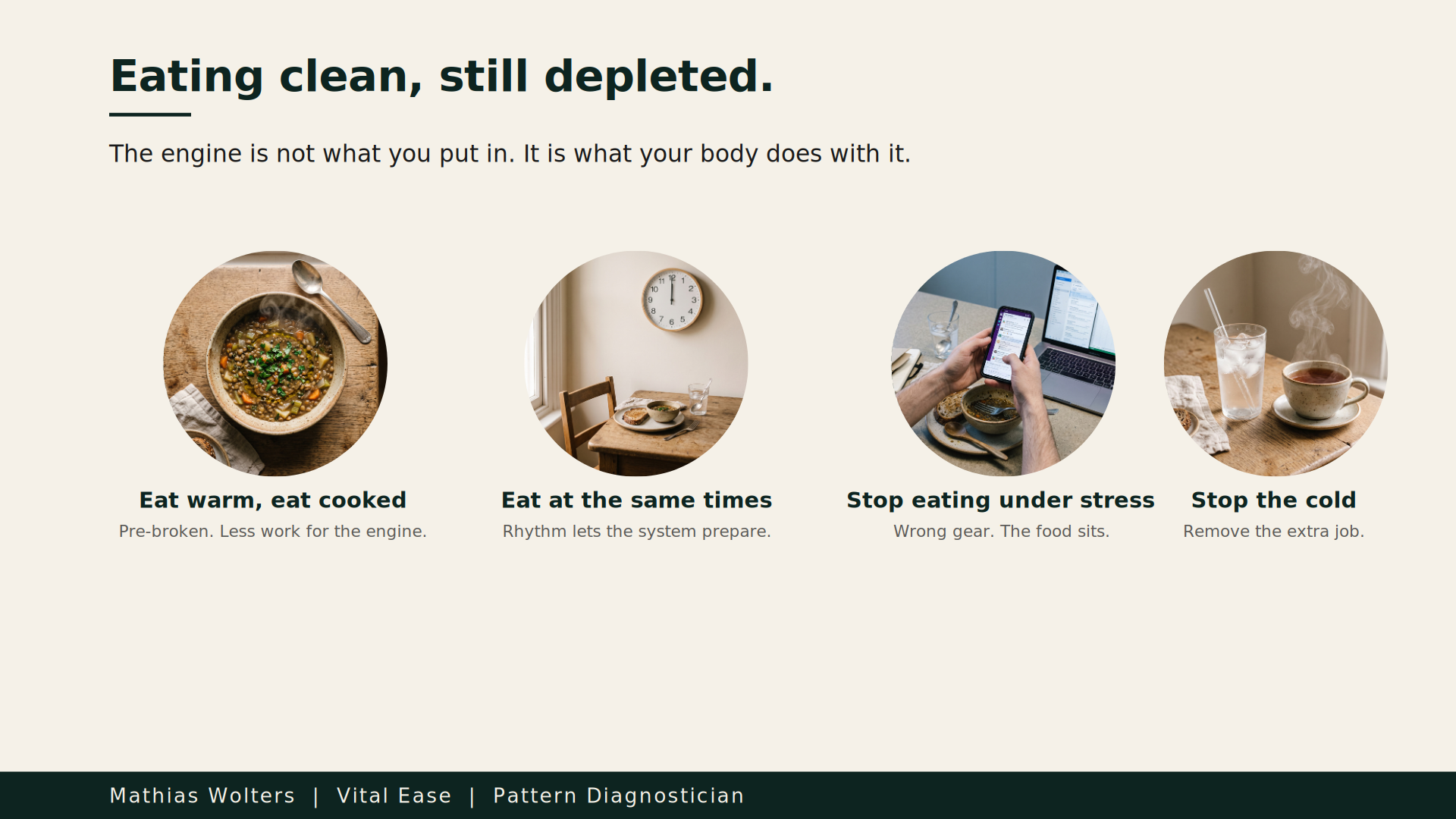
Eat warm, eat cooked.
This is the single largest lever, and it is the one most founders resist because it contradicts everything they have been told about clean eating.
Raw, cold food costs the conversion engine work before a single nutrient is extracted. The system has to warm it, break down the fibre structure, and process the raw material before absorption can begin. A strong engine handles this easily. A weak one spends its limited capacity on the warming and the processing and has nothing left for the extracting.
Cooked food arrives pre-broken. The heat has already done part of the work. A warm bowl of soup or stew delivers the same nutrients as a raw salad at a fraction of the conversion cost. This is not a nutrition opinion. It is a physics argument about where the energy goes.
Switch lunch. That is the move. The cold salad becomes a warm bowl with cooked vegetables, protein, and something slow like rice or sweet potato. Same ingredients, different state. Watch what happens to the after-lunch heaviness inside a week.
Eat at the same times.
The engine works on rhythm. Irregular input means the system never knows when to ramp up acid, bile, and enzymes, so it stays partially ready all the time and never fully ready when the food arrives.
Three meals. Roughly the same time each day. Real gaps between them, nothing in the gaps except water. The system learns the schedule and begins to prepare, which is most of the work.
Stop eating under stress.
A conversation, a call, a screen with numbers on it. If you are eating while your system is in work mode, the nervous system is in the wrong gear for digestion. Blood is in the brain and the muscles, not in the gut. Acid production drops. Motility slows. The food sits.
Sit down. Put the phone away. Chew slowly. Give it ten minutes without input. This sounds trivial and it is the intervention most of my patients report feeling first.
Stop the cold.
No ice in the water. No cold drinks with meals. No smoothie for breakfast. Not because cold food is bad in some abstract way. Because a weak engine that is already struggling to transform what arrives does not need the additional job of warming it first. Remove the cold and the system has more capacity for the actual work.
When the engine needs more than habits
If the conversion has been failing for years, and especially if the multi-nutrient pattern is entrenched and the fatigue is deep, the changes above will help but they will not finish the job. The engine is not just underperforming. It is depleted. The fire underneath the transformation has gone low enough that habits alone cannot bring it back.
This is where the tradition I trained in has its deepest practical edge. Chinese Medicine has been reading this exact pattern for a very long time, and the herbal approach is specific: warm the centre, strengthen the transformation, support the deep reserve that powers it. Not from the outside in, not by replacing what is missing, but by rebuilding the function that is supposed to produce it.
That is clinical work. Herbs matched to the pattern, prescribed in a sequence that respects what the system can handle. Not a protocol. A reading.
But the warm food, the regular meals, the calm table, the end of the cold intake. That is the foundation the clinical work sits on, and it is worth starting today regardless of where the engine is. Everything downstream works better when the input matches what the system can actually transform.
Before you close this
If you are taking more than five supplements and you are still tired, stop and ask the question nobody asked you. Why are all of these low at the same time.
If the answer is that the diet does not contain them, fix the diet. If the answer is that the diet is fine and they are still low, the engine is the problem, and adding more capsules is adding grain to a mill that cannot turn.
Switch one meal. Make lunch warm and cooked this week. Sit down, chew, put the phone away. Drop the cold drinks. See what the after-lunch heaviness does.
You are not failing at nutrition. Your body is failing at conversion, and that is a different problem with a different fix. The fix is not harder. It is warmer.
Mathias
P.S. The Sovereign Biological Audit reads 40 markers across eight biological systems against functional optimums rather than population averages. It finds the conversion pattern underneath the scattered deficiencies and shows you whether the engine is the bottleneck. vitalease.co/sovereign-biological-audit