The fat your diet will never reach
My patient John had tried four diets in five years. Each one worked for a while. Each time the weight came back, and each time it came back to the same place.
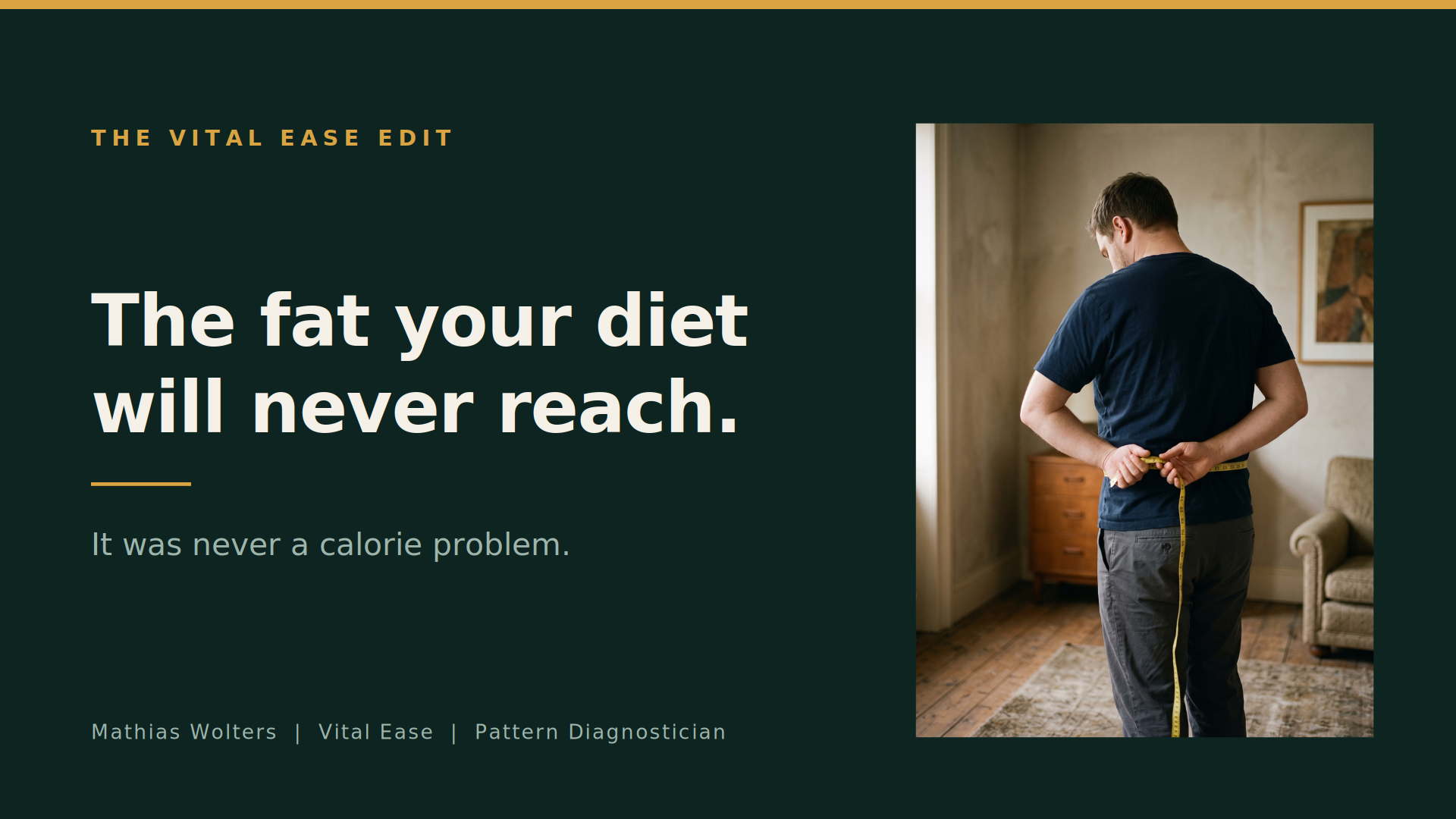
My patient John had tried four diets in five years. Each one worked for a while. Each time the weight came back, and each time it came back to the same place. Not his arms, not his legs, not under the skin where you can pinch it. Around his middle, deep, packed tight around the organs.
He was not lazy. He was not undisciplined. He was a man who had been told the same thing by every professional he saw, which was to eat less and move more, and he had done it, repeatedly, and the belt still did not lie.
When he sat in front of me his blood showed inflammation markers running and clear signs of depletion. The body reading told the same story from the other end. Everything running slow, weak, thin. A system that could not transform what came in and could not burn off what had accumulated. And underneath that, a thick, heavy, slightly hot residue that had been building for years and was now sitting around his organs doing damage.
That is not body fat the way most people understand body fat. That is a different thing entirely, and it needs to be spoken about plainly, because most founders carrying it have no idea what it actually is, what it is doing to them, or why nothing they have tried has reached it.
What this gives you
A clear explanation of why the fat around your middle does not respond to the same rules as the fat everywhere else, which markers tell you whether you have a problem, and what actually shifts it. This is not a gentle piece. If you are carrying visceral fat, you need to know what it is doing while it sits there.
This fat is not storage. It is active tissue.
Subcutaneous fat, the fat under your skin, is mostly inert storage. You eat more than you burn, it accumulates. You eat less, it reduces. That is the fat the caloric model was built for, and for that fat, the model works.
Visceral fat is different. It wraps around the liver, the kidneys, the intestines, the pancreas. And it is not sitting there quietly. It is metabolically active. It produces inflammatory signals continuously. It drives insulin resistance from the inside. It raises your cardiovascular risk independent of your total body weight. A man with a normal BMI and high visceral fat is at greater risk than a heavier man who carries it under the skin.
This is not a cosmetic problem you can afford to get around to. It is an inflammatory engine running inside you, and the longer it runs, the harder it becomes to turn off, because the fat itself creates the hormonal conditions that keep it in place.
Why your diet did not reach it
Two mechanisms, and neither of them is caloric.
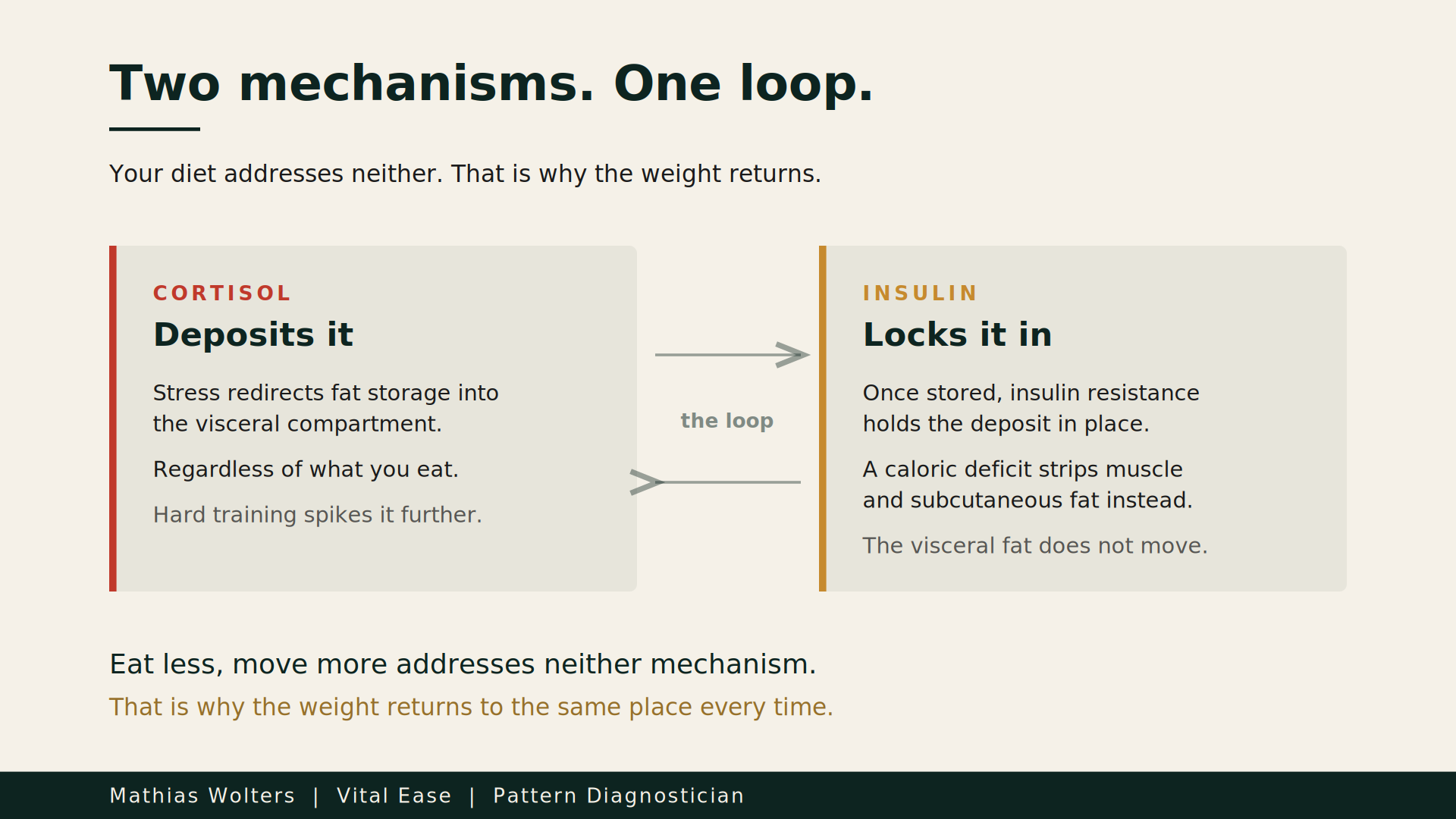
Cortisol. When you are under sustained stress, cortisol does something specific with fat storage. It redirects it into the visceral compartment. Not under the skin. Around the organs. This happens regardless of what you eat. A founder running on four hours of sleep and back-to-back calls is depositing visceral fat even on a clean diet, because the signal to deposit is hormonal, not caloric.
And here is the part that should stop you. Hard training, the six a.m. grind, the heavy sessions, the high-intensity work that was supposed to burn the fat, that spikes cortisol. You are adding the same hormone that drives visceral deposition, in the name of reducing it. The harder you train, the more you deposit. Not every time, not in every body, but in a system that is already stressed and depleted, this is exactly what happens, and it is exactly what happened with John.
Insulin. Once the visceral deposit is there, insulin resistance locks it in place. The fat drives insulin higher, higher insulin drives more storage, and the loop closes. A caloric deficit does not break this loop. You eat less, your body holds the visceral fat and strips the subcutaneous fat and the muscle instead. You lose weight on the scale, you lose it from the wrong places, and the dangerous deposit does not move.
This is why the weight comes back. The mechanism that put it there was never addressed. The diet addressed intake. The problem was never intake.
The markers that tell you where you stand
You need a tape measure and one blood draw.
Waist circumference. Measure at the navel, standing, breathing out normally. For men, above 94 centimetres is the line where visceral risk rises. For women, above 80 centimetres.
Those are the WHO thresholds, and they hold across most populations.
If you want the precise picture, ask for a DEXA scan. It separates visceral from subcutaneous and gives you a number. John's scan showed the full extent of what his mirror had been telling him for years.
Fasting insulin. The same marker from No. 18 of this newsletter. If it is elevated, the lock is in place. Your body is holding the visceral deposit regardless of what you eat.
Morning cortisol. If this is high, the deposit mechanism is still running. You are still adding to the compartment under stress, and training harder is making it worse.
Triglycerides divided by HDL. The same ratio from No. 18. Tracks the metabolic load from a different angle.
hs-CRP. High-sensitivity C-reactive protein. This is the inflammation marker. If it is elevated and you have visceral fat, the fat is actively producing the inflammatory signal. Not might be. Is.
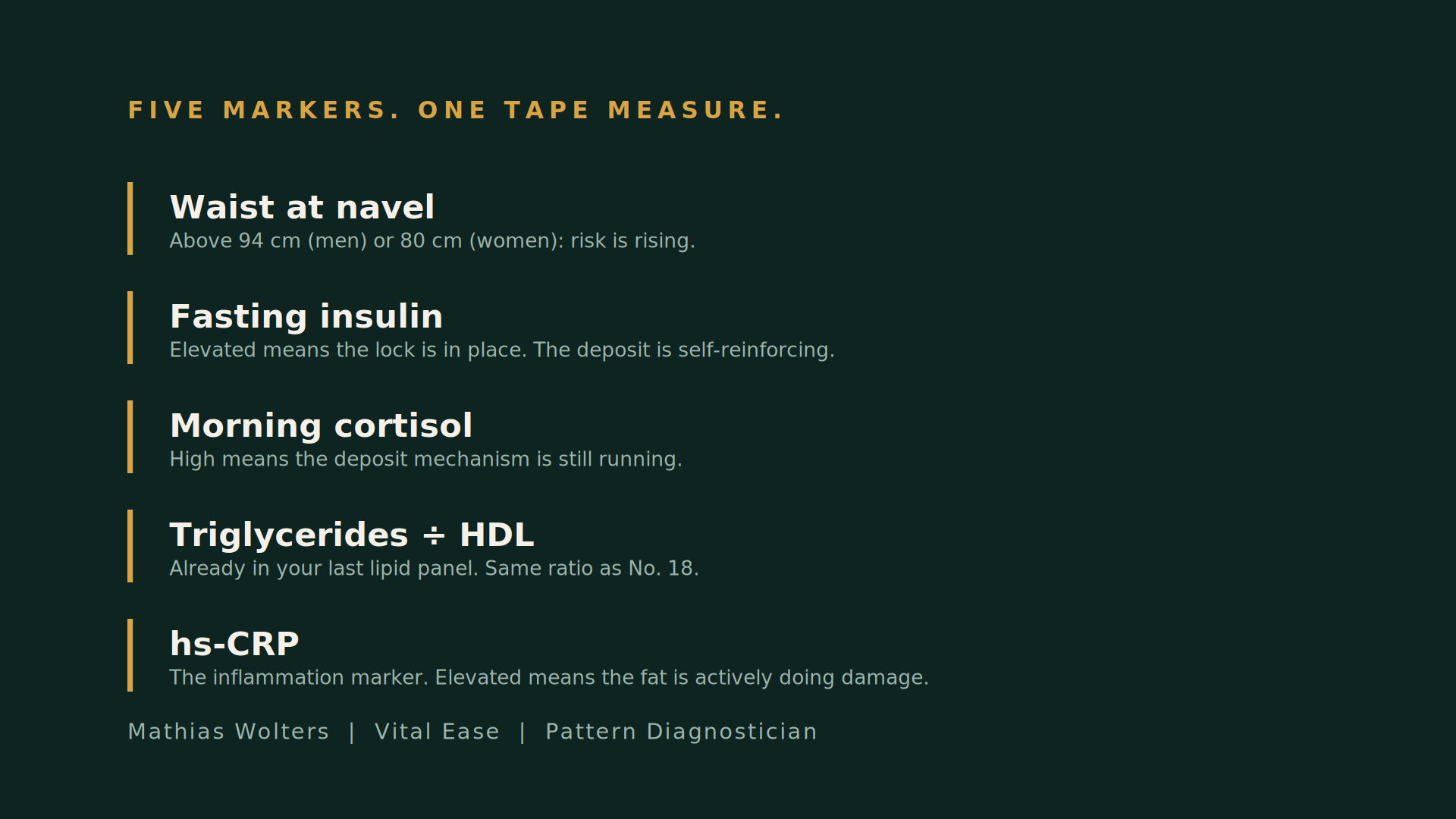
Those five, plus the tape measure, tell you whether the mechanism is cortisol, insulin, or both, and how much inflammatory damage is already running.
What actually shifts it
Not less food. Not harder training. Both of those were aimed at the wrong system.
Lower the cortisol first. This is non-negotiable. If the deposit mechanism is still running, nothing downstream will hold.
Stop the six a.m. high-intensity session. Replace it with a walk. Not because walking burns visceral fat. Because it does not spike cortisol while still improving insulin sensitivity. The walk after meals is the single best trade you can make, ten minutes, no cost, no cortisol, measurable effect on glucose clearance.
Close the evening. Stop eating three hours before bed. Stop the input, stop the screen, let the system come down. The same evening gap from No. 18. It serves the insulin and the cortisol at the same time.
Breathe. A long out breath activates the recovery side of the nervous system and brings cortisol down in real time. Five minutes, three times a day. You have read this before in this newsletter. It matters more here than in any other context, because the cortisol is not just making you tired. It is depositing fat around your organs while you sit in a meeting.
Break the insulin lock. Fasting insulin has to come down. The inputs are the same as No. 18: the evening gap, protein before starch, warm cooked food, real gaps between meals. When insulin drops, the visceral compartment unlocks and the body can finally access what is stored there.
Rebuild the fire underneath. This is where my work with John went beyond what a list can do, and it is worth saying plainly.
His system had lost the capacity to transform what arrived. Food was coming in and sitting as heavy, damp, hot residue rather than being converted into usable warmth and material. The same pattern I have described in this newsletter before, but further along. The fire was not just low. It was buried under years of accumulation, and the accumulation itself was producing heat and inflammation, which made the picture worse.
We warmed the middle of him. We supported the deep engine underneath. We cleared the residue in layers, carefully, because clearing too fast in a depleted system makes things worse before they get better. He did Qigong and walking instead of grinding. He ate warm, nourishing, protein-rich food and dropped the refined carbohydrates. Not a punishment diet. A diet that matched what his system could actually transform.
Chinese herbs did the work that lifestyle changes could not reach. They rebuilt the fire, supported the deep reserve, and cleared the damp residue that was sitting around his organs producing inflammation. That is not something a supplement does. It is a precise clinical prescription matched to the pattern in front of me.
Three months later John had lost roughly 20 kilograms. [VERIFY: confirm exact weight loss with Mathias] His energy was back. His inflammation markers had come down. His belt told a different story. He said he felt like a new man, which is what people say when something that has been sitting in them for years finally clears.
What he did not do
He did not eat less. He ate differently.
He did not train harder. He trained less, and slower, and the fat moved because the hormonal signal to hold it finally dropped.
He did not white-knuckle a twelve-week protocol. He rebuilt the system that was supposed to be handling this all along, and once the system came back online, it did what it was built to do.
That matters, because the conventional approach to visceral fat is a harder version of the thing that already failed. More discipline. Fewer calories. Bigger deficit. Tougher training. And the founder who has tried that three times and watched the weight return each time is not weak. He was following instructions that were aimed at the wrong mechanism.
Before you close this
Measure your waist tonight. At the navel, standing, breathing out normally. Write the number down.
If it is above the line, do not start another diet. Get the blood draw. Fasting insulin, morning cortisol, triglycerides, HDL, hs-CRP. Find out which mechanism is running, because until you know whether this is cortisol, insulin, or both, every intervention is a guess, and you have already spent years guessing.
This fat does not wait. It is not an aesthetic inconvenience you will get around to. It is driving inflammation, insulin resistance, and cardiovascular risk right now, today, while your other numbers look fine.
The good news is the lever is not harder than what you have already been doing. It is different. And different, for this one, works.
Mathias
P.S. Visceral fat shows up in the waist. What drives it shows up in the blood. The Sovereign Biological Audit reads 40 markers across eight biological systems against functional optimums rather than population averages. It finds whether the mechanism is cortisol, insulin, or both, and what your reserve can carry while you shift it. vitalease.co/sovereign-biological-audit