Stop taking your work home. Settle your Nervous System
You finished work hours ago. Your body didn't get the message. Here's how to send it.
You finished work hours ago. Your body didn't get the message.
Here's how to send it.
A founder I worked with, I'll call him Kraus, came to me burned out. Not dramatic about it. Just worn flat. He'd lost the thread of what came next, and he couldn't switch off to find it. He'd close the laptop and his body stayed switched on, running, like an engine idling high in a parked car.
I know a quieter version of it myself. I can switch off fine. But I sit down at my desk in the morning, and I see it all at once, everything I have to do, everything I want to do, the whole mountain. The stress isn't in the work. It's in the seeing.
Different shapes, same root. The nervous system is running when it should be resting, and no amount of deciding to relax makes it stop.
Most people try to fix this with their mind. Think calmer. Reframe it. Talk themselves down. It rarely works, and here's why: the nervous system isn't listening to your thoughts. It's a physical system, and it settles through the body, not through the mind. You don't think your way calm. You settle from the bottom up.
That's the whole idea behind today's newsletter. I'll show you how to actually settle a nervous system that won't switch off, and you can start at Level 1 today.
Level 1 — The fastest way in: the breath
This is the doorstep, and it's free, and you can do it in the next two minutes.
Make your exhale longer than your inhale. Breathe in through the nose for a count of four, then out, through the nose or softly through the mouth, for a count of six or eight. Keep it smooth, not forced. That's the whole practice.
Here's why it works, because it's not a relaxation trick, it's a physical switch. Your nervous system has two settings, roughly, the one that revs you up and the one that brings you down. The out-breath is directly wired to the settling side. A long, slow exhale is one of the only conscious levers you have that reaches straight into that system and turns the dial down. You're not talking your body into calm. You're operating the switch by hand.
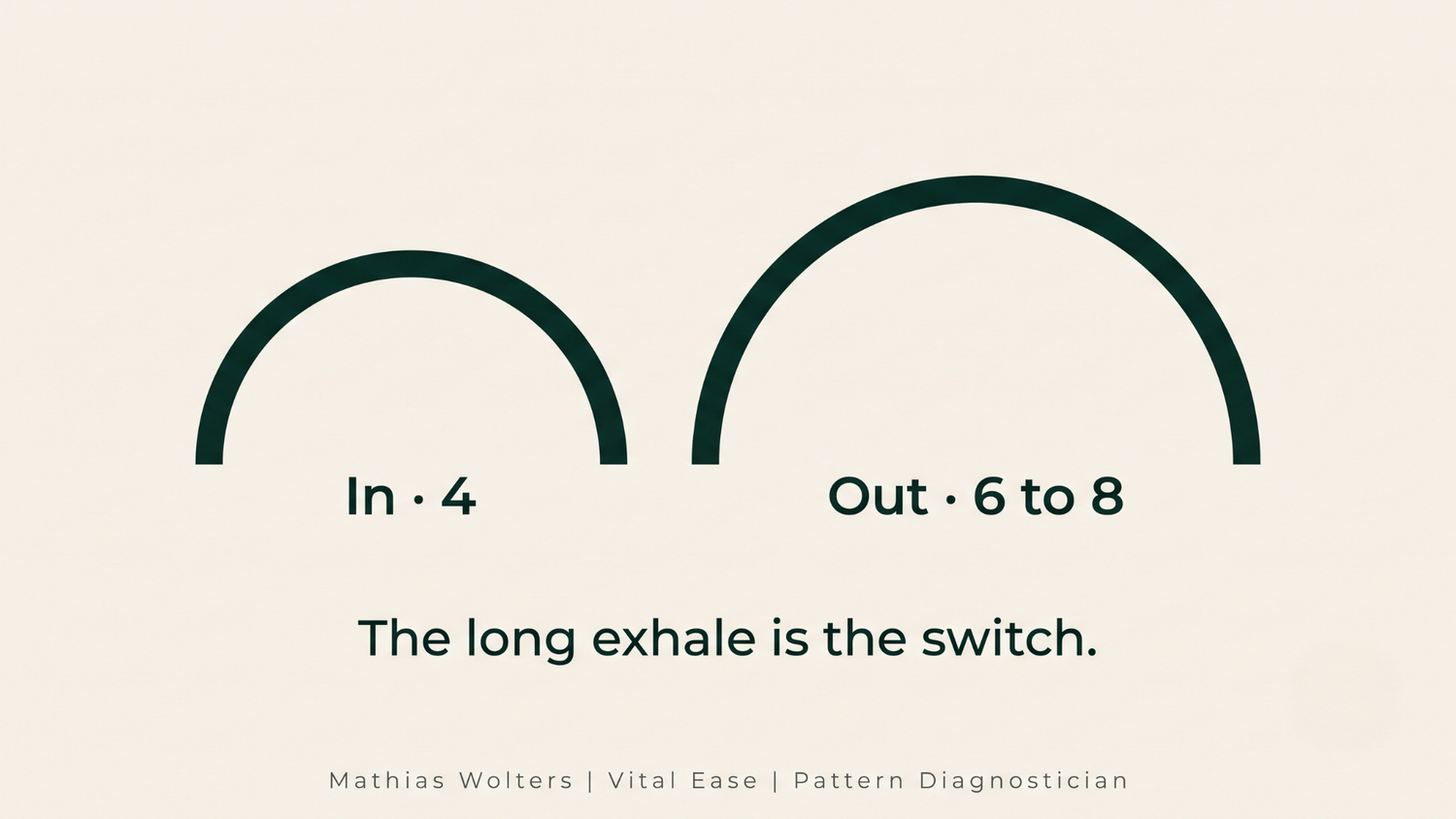
Use it in three places. When you catch the engine idling high at your desk. In the sixty seconds before a hard call, instead of bracing into it. And in the evening, when the work is done but the body hasn't noticed. Two minutes each time.
You'll feel the shift while it's happening, a small drop, a loosening. That felt shift is the point. It teaches the body that it can come down on command, which is exactly the thing a wired system has forgotten how to do.
Level 2 — The body's own settling: standing still
There's a practice I've done and taught for close to thirty years. In Chinese Medicine and the Daoist tradition it's called Zhan Zhuang, standing like a post. It looks like nothing is happening. It's one of the most powerful things I know for a nervous system stuck on high.
Here is how to actually do it.
Stand with your feet about shoulder-width apart, parallel, toes pointing forward. Let your knees soften, not bent deep, just unlocked, so they're not rigid. Tuck your tailbone very slightly, so your lower back lengthens instead of arching. Let your shoulders drop. Now raise your arms in front of your chest as if you're loosely holding a large ball against your body, elbows a little below the hands, fingers relaxed and slightly apart. Hands stay soft. Chin very slightly in, as if a thread lifts you from the crown of your head.
Then you simply stay. Breathe naturally, long and low into the belly. Let the weight sink into your feet. Do nothing else.
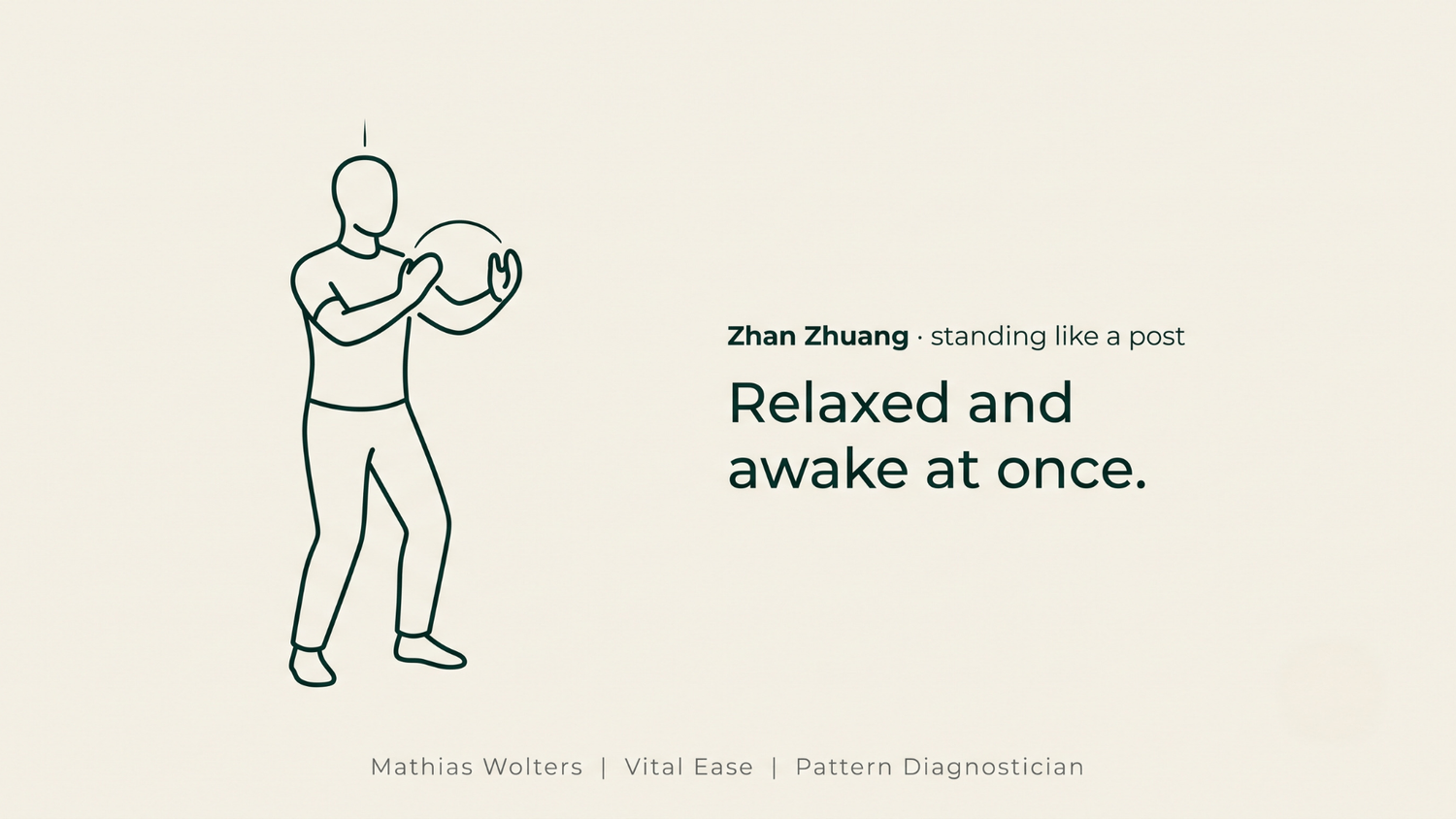
Two things will happen. First, within a minute or two, parts of your body will start to shake or ache, the shoulders usually. That's not a problem, it's the chronic bracing you carry all day finally being asked to show itself. Let it be there. It passes. Second, if you keep standing, the tension has nowhere to go, so it drains downward, out through the legs and feet, and what's left is a kind of settled alertness.
Relaxed and awake at once.
That last state, relaxed and awake at the same time, is the whole thing I teach. It's what a nervous system is supposed to feel like, and most founders haven't felt it in years.
Start with three minutes. If three is too long at first, do one. Build slowly toward ten. The couch keeps the mind busy and the body braced. Standing still gives the body nothing to do but let down. That's the difference, and you feel it the first time.
Level 3 — The daily levers
These are the background conditions. Level 1 and 2 are what you do in the moment. These are what let the nervous system settle on its own the rest of the time.
Sleep on a steady schedule. A nervous system stuck on high runs the night the same way it runs the day. If you go to bed and rise at wildly different times, the system never learns when it's allowed to power down. The regularity matters more than the exact number of hours, pick a window and hold it, even on weekends.
Get light in your eyes early. Within the first hour of waking, get outside, or at least to a bright window, for a few minutes. Morning light is the strongest signal your body has for telling the time of day, and it quietly sets the whole cycle, when you ramp up in the morning and, just as importantly, when you're allowed to come down at night. Miss it and the whole rhythm drifts late.
Check your head and your feet. Here's a fast read on your own state, straight from Chinese Medicine and easy to feel. Hot or busy head, cold feet, that means the energy has risen and stayed up. It's the classic stressed pattern, running on top. When you're genuinely settled, it reverses, the head cools and clears, the feet warm. You can feel it change in real time as the breath and the standing do their work. It's the simplest self-check I know, and it costs nothing.
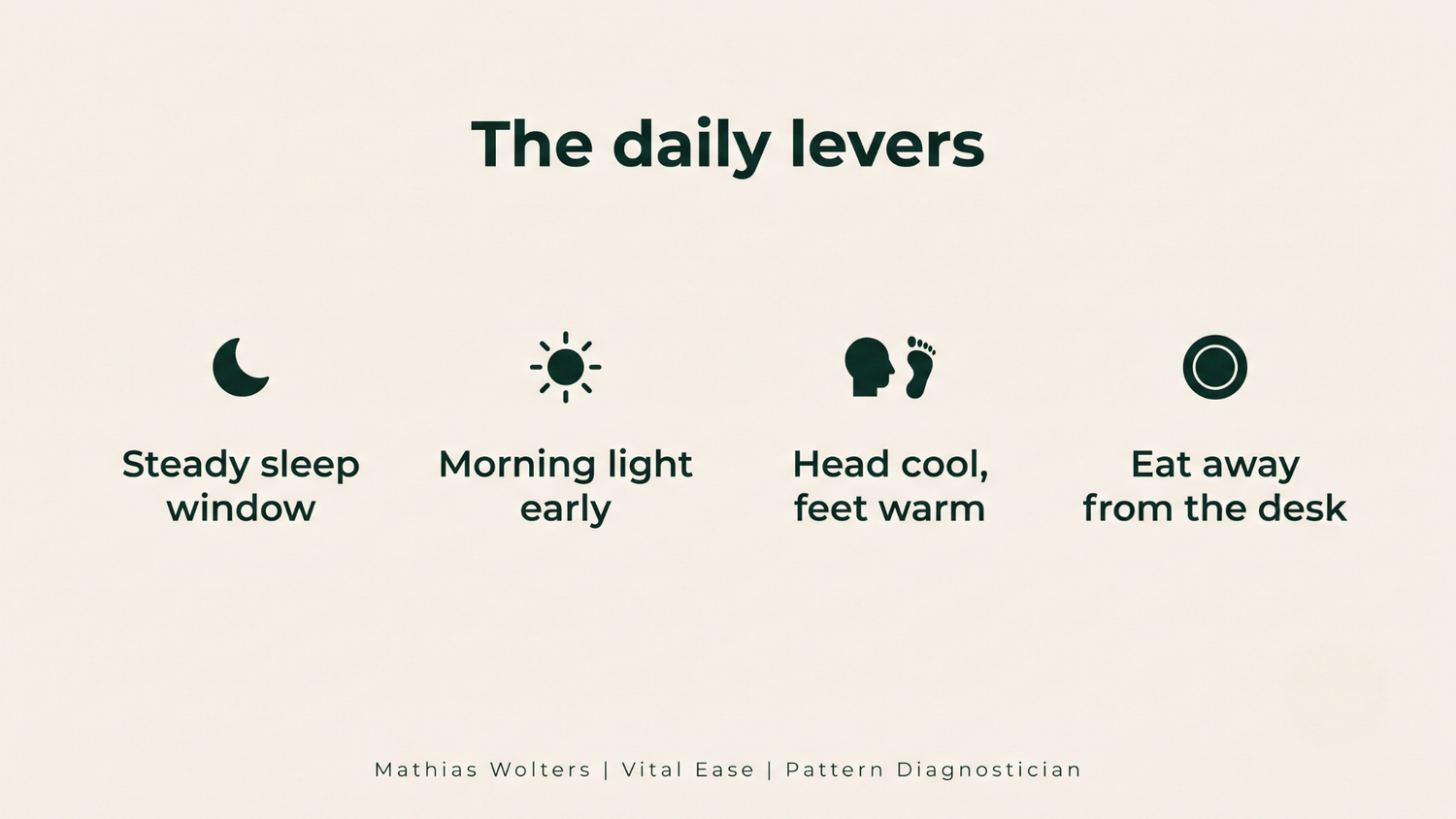
Don't eat at your desk. The body cannot settle and digest while it's braced for the next message. Wolfing lunch over Slack keeps the whole system on alert through the one part of the day it could have used to come down. Sit somewhere else. Take one slow breath before the first bite. It sounds trivial. It's one of the most common and most fixable stress leaks I see.
Level 4 — When it's deeper than lifestyle
Sometimes you do all of the above and the system still won't come down. The wiring stays hot. That's not a willpower problem, and it's not you doing Level 1 wrong.
It means the pattern underneath is deeper than lifestyle can reach, and it needs reading. That's the layer where I work, finding what's actually holding the system on high, in the body and in the blood, and where to start to let it down. But you don't begin there. You begin with the breath.
Don't turn this into another thing to grind at
If you've read this far, sit back and take one long breath out. Right now.
The whole point of this is ease, not another project to attack. You're not meant to do all four levels this week. Start with the breath. When the body learns it can come down, the rest follows, and you'll want the next piece on your own.
That's the thing most founders never feel, that real steadiness isn't the absence of pressure. It's what a settled body sits under. You can carry a mountain of things to do and still be settled underneath it. That's not calm instead of power. That's where the power actually comes from.
Start with the breath. You've got time.
— Mathias