VO2 Max — Build the engine. Keep the flame.
The Engine and The Pilot Light — Why VO2 MAX is The Longevity Number Nobody Tracks and Neither East nor West Can Maximise it Alone. The Number That Predicts Everything
The Engine and The Pilot Light — Why VO2 MAX is The Longevity Number Nobody Tracks and Neither East nor West Can Maximise it Alone. The Number That Predicts Everything
There is a number that predicts, with more precision than almost any other biomarker in clinical medicine, whether a founder will be alive and functional at seventy-five.
Not his cholesterol. Not his fasting glucose. Not his testosterone. Not his HRV, his cortisol curve, or his biological age score from a longevity clinic.
His VO2 Max.
The maximum volume of oxygen his body can absorb, transport, and convert into usable energy during intense exertion. A single number — measured in millilitres of oxygen per kilogram of bodyweight per minute — that reflects the combined efficiency of his lungs, his heart, his blood, and his mitochondria simultaneously.
Western medicine's longevity data on this marker is not subtle. Moving from a low VO2 Max to an elite one reduces all-cause mortality — the risk of dying from any cause — by up to fifty percent over a given period. No pharmaceutical intervention, no dietary protocol, and no supplement stack comes close to that magnitude of effect.
And yet almost no founder has ever tested it. Almost none have trained specifically for it. Most do not know where they stand — and those who do have confused it with general fitness rather than understanding it as the single most measurable expression of biological longevity capacity available to them.
This is not a fitness metric. It is a clinical reading of how much life the hardware can sustain — and for how long.
The question is not whether to build it. The question is whether the founder understands what building it actually requires — and what the system he builds it with will cost him if he gets only half the architecture right.
What the Engine Actually Requires
Because VO2 Max is the single most powerful longevity biomarker available, the next question is precise: what does the body actually need to build it — and what is the stimulus that forces the hardware to grow?
The answer begins with the heart.
Specifically with the left ventricle — the chamber that receives oxygenated blood from the lungs and pumps it out to the entire body. In a sedentary founder, this chamber is modest in size and modest in output. It pumps what the body asks for, which in a life lived mostly at a desk is not very much. The heart is not lazy. It is simply not being asked a hard enough question.
Zone 2 cardio asks the first question. Forty-five to sixty minutes of sustained moderate effort — the pace at which a full conversation is still possible but breathing has deepened — forces the body to build the cellular infrastructure that VO2 Max depends on. Capillary networks expand inside the muscle tissue. The number of mitochondria per cell multiplies. The muscles become more efficient at extracting oxygen from the blood that passes through them. This is the canvas. Without it, nothing else compounds.
The Norwegian 4x4 asks the second question — and it is a harder one. Four minutes at ninety to ninety-five percent of maximum heart rate, repeated four times with three minutes of active recovery between each round. At this intensity the left ventricle is forced to work at absolute capacity — filling and emptying at maximum volume, repeatedly, for long enough that the heart muscle itself must structurally adapt. The chamber stretches. The walls thicken. Stroke volume — the amount of blood pumped per beat — increases permanently.
This is not fitness. This is cardiac remodelling. The Western stimulus is the sympathetic system activated under controlled load — cortisol, adrenaline, the biological signal that the organism must grow or fail.
The hardware expands because the demand was real.
The Ceiling the West Cannot See
Because the Western stimulus forces the hardware to grow through sympathetic activation, the founder who trains consistently begins to see real results. VO2 Max climbs.
Resting heart rate drops. The left ventricle remodels. The mitochondrial density increases. By every Western metric, the protocol is working.
And then, at some point, it stops working.
The plateau is so common in exercise physiology that researchers have named it. But the mechanism beneath it is rarely explained honestly — because explaining it honestly requires acknowledging something the high-performance culture finds deeply uncomfortable.
The sympathetic system that builds the engine is the same system that, when chronically activated without adequate parasympathetic counterbalance, begins to prevent the engine from consolidating what it has built.
Here is the precise biological sequence. High-intensity training spikes cortisol. Cortisol is the adaptation signal — it tells the body that the environment is demanding and the hardware must grow. But cortisol also suppresses the parasympathetic recovery window in which the adaptation actually consolidates. Tissue repairs in parasympathetic mode. Mitochondria replicate in parasympathetic mode.
The left ventricle remodels most efficiently when the nervous system has fully downregulated between sessions.
The founder who is already running elevated cortisol from a decade of chronic stress — whose evening cortisol curve has not properly fallen in years, whose HRV reflects a nervous system that cannot fully exit the last meeting — adds high-intensity training to a system that has no parasympathetic window left to consolidate the adaptation.
He builds. He breaks down. He rebuilds the same ceiling.
In Chinese Medicine this is not a training problem. It is a Yin deficiency problem. The Yang is firing — the stimulus is real, the effort is genuine. But the Yin that should receive and consolidate what the Yang produces has been depleted. The engine grows. The fuel to run it cleanly does not.
This is the ceiling Western science measures but cannot name.
The Eastern Engine
Because the Western stimulus builds the hardware but cannot consolidate what it builds without parasympathetic restoration, the question becomes precise: what system was designed — not as recovery, not as alternative medicine, but as a complete cardiovascular and energetic architecture in its own right — to do exactly what the West has been missing?
The internal arts contain the answer. And they contain it completely.
In Chinese Medicine, the cardiorespiratory system is governed by Zong Qi — the Chest Qi formed when the Lungs receive clean air and combine it with the nutritive essence the Spleen extracts from food. Zong Qi is not a metaphor for oxygen. It is the functional description of the same process Western medicine calls cardiorespiratory efficiency — the combined capacity of lungs, heart, and cellular metabolism to capture, transport, and convert oxygen into usable energy. Two systems. Two languages. The same engine.
But Chinese Medicine goes one layer deeper. While the Lungs govern the intake of breath, the Kidneys govern its reception. A founder can have structurally healthy lungs and still breathe shallowly — the breath trapped in the upper chest, the diaphragm underused, the air never descending into the lower abdomen where the Dantian can grasp and anchor it. This is Kidney Qi failing to receive — a powerful intake system connected to a collapsed delivery network.
Slow, deliberate, abdominal movement — as found in Taiji, Ba Duan Jin, or any Qigong practice rooted in this principle — trains the Kidneys to pull the breath downward. The diaphragm activates at its full range. And here is what
Western exercise physiology has not yet fully named: sustained, slow, continuous movement practiced over thirty to sixty minutes is Zone 2 cardio. The metabolic stimulus is identical — low intensity, parasympathetic, mitochondrial. The Eastern form simultaneously restores what the movement costs rather than creating a recovery debt the founder must repay.
The deep stances that punctuate these forms — Horse stance, low GongFu positions held under genuine structural load — are isometric loading. The lower body generates the root. Chinese Medicine calls this stoking the Kidney Yang fire — the metabolic heat that drives the entire energetic system upward into the chest, feeding the Zong Qi from below.
And then Fa Jin (explosive power movements) arrives. This is the Eastern equivalent of the Norwegian 4x4 — but the neurological signature is entirely different. Fa Jin is not aggression. It is maximum power discharged from a state of deep internal structural calm. The body produces its highest output not from sympathetic activation but from the complete, instantaneous release of stored structural tension. The metabolic clearance is identical to a sprint interval. But the nervous system that generates it is parasympathetic at its root — and returns there immediately after the discharge.
The Eastern system already contains everything the West discovered separately. Zone 2 in the slow continuous forms. Isometrics in the deep stances. High-intensity intervals in the Fa Jin. Embedded inside a single practice architecture that builds the engine and restores it simultaneously.
This is not the alternative to Western training. It is its completion.
The Complete Protocol
Because the Eastern system already contains the full cardiovascular spectrum — Zone 2 in the slow continuous forms, isometrics in the deep stances, Fa Jin as high-intensity discharge from structural calm — the question is no longer which system to choose. The question is how to marry both inside a weekly architecture that a founder over forty can actually sustain.
The answer is not complicated. But it requires precision about sequencing — because the order in which these stimuli arrive determines whether the nervous system consolidates the adaptation or simply accumulates the load.
The Foundation — three times per week: Zone 2 cardio. Forty-five to sixty minutes at conversational pace. Running, cycling, swimming — the modality is secondary. The stimulus is primary: sustained, low-intensity, parasympathetic aerobic work that expands the capillary network, multiplies mitochondrial density, and builds the cellular canvas that everything else requires. Without this foundation, high-intensity work hits a structural ceiling it cannot push through.
The Ceiling Push — once per week: The Norwegian 4x4. Four minutes at ninety to ninety-five percent of maximum heart rate, four rounds, three minutes active recovery between each. This is the cardiac remodelling stimulus — the left ventricle forced to operate at maximum stroke volume long enough to structurally adapt. One session per week is sufficient. More is not better. The founder already carries a chronic sympathetic load. One precise high-intensity session per week pushes the ceiling without adding to the biological debt.
The Eastern Foundation — daily: Slow continuous movement — Taiji, Qigong, or GongFu forms practiced at full deliberate pace for twenty to thirty minutes. This is not warm-up. This is the parasympathetic restoration layer that consolidates everything the Western sessions produce. The Kidney Qi learns to receive the breath. The Zong Qi builds from below rather than being forced from above. The mitochondrial adaptations triggered by Zone 2 and the Norwegian 4x4 consolidate during this daily practice — because the nervous system is finally given the signal that it is safe to complete what the effort began.
The Fa Jin Sessions — two to three times per week: Embedded within the GongFu or Qigong practice. Brief, precise, complete. Maximum power discharged from deep structural calm — the nervous system producing its explosive ceiling without cortisol activation. These sessions do not add sympathetic load. They teach the body to access its maximum output from a parasympathetic root — and then return there immediately.
The sequencing principle is simple: Western stimulus creates the demand. Eastern practice creates the conditions in which the body can answer it.
The Pilot Light
Because the complete protocol marries Western stimulus with Eastern restoration, the founder who builds both sides of this architecture arrives somewhere that no single-system approach has ever reliably delivered.
Not just a higher VO2 Max. A body that can sustain what it has built.
This distinction matters more than the number itself. Western exercise science can take a motivated founder from a low VO2 Max to a respectable one inside six months of disciplined training. What it cannot guarantee is that the adaptation holds — that three years later the number is still climbing rather than quietly declining as the chronic cortisol load, the compressed recovery windows, and the borrowed biology finally collect what was owed.
The Eastern system is not the efficiency hack that makes the Western protocol work better. It is the condition without which the Western protocol eventually consumes itself.
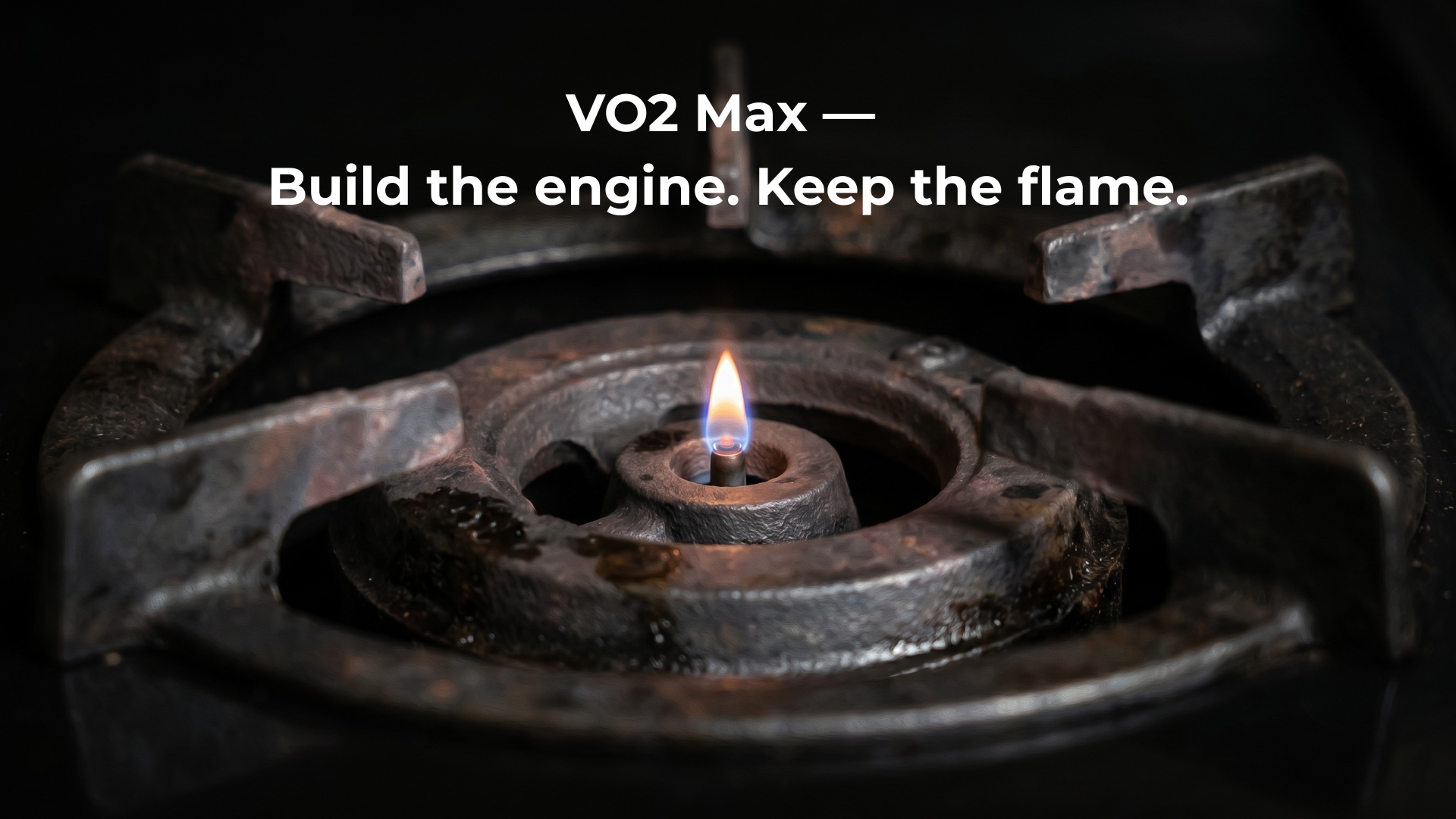
In Chinese Medicine the image for this is the pilot light — the small, constant flame that must remain burning for the larger fire to ignite when it is needed. This is the Kidney Yang — not the explosive output of a sprint session or the cortisol surge of a high-stakes decision, but the quiet, steady, metabolic warmth that keeps the entire energetic system viable between demands.
Chronic sympathetic activation without parasympathetic restoration extinguishes this flame slowly. Not dramatically. The founder does not feel it going out. He feels it as the training sessions that produce less return than they used to. As the recovery that takes longer than it did at thirty-five. As the morning that arrives without the readiness it once carried.
The pilot light does not go out because the founder stopped caring. It goes out because he never learned that caring for it was part of the work. And that — not productivity, not optimization, not performance metrics — is what this work is actually about. Restoring the biological and emotional conditions in which health, clarity, meaningful work, and a good life naturally emerge.
The VO2 Max is not the destination. It is the measure of a system that has learned to build and to restore in equal proportion — Yang and Yin, stimulus and recovery, the Western engine and the Eastern intelligence that knows how to run it without spending what cannot be replaced.
Build the engine. Keep the pilot light burning.
That is the complete architecture.