Where is your drive
He did not come in about testosterone. He came in about something he could not name.
He did not come in about testosterone. He came in about something he could not name.
The sharpness was gone. Not the intelligence, that was still there, but the thing underneath it. The thing that used to make him get up before the alarm and start building before the coffee was ready. The drive that used to sit in him like a low engine, always running, always warm.
It had gone quiet, and he did not know when.
His doctor ran a panel. Testosterone came back low. Not catastrophically low, but below range. And the offer came fast: replacement. A gel, a shot, a pellet, something to put back what was missing.
Nobody asked why it was missing.
The question that does not get asked
Testosterone does not fall for no reason. It falls because something upstream told it to.
There is a loop. Your brain reads the level, and if it is low, the brain sends a signal down to produce more. That signal has a name, LH, and it is measurable. The whole system is a conversation between the brain and the glands, and it runs itself.
When testosterone drops, there are only two possibilities.
The brain is still asking and the body cannot deliver. That is a production problem. The factory is tired.
Or the brain stopped asking. Something higher up shut the signal down, and the factory went quiet because nobody placed an order.
Those are completely different problems. One is a depleted system. The other is a suppressed one. And the treatment for one makes the other permanently worse.
That is the question nobody asked my patient. Not why is it low, but which kind of low.
The markers that answer it
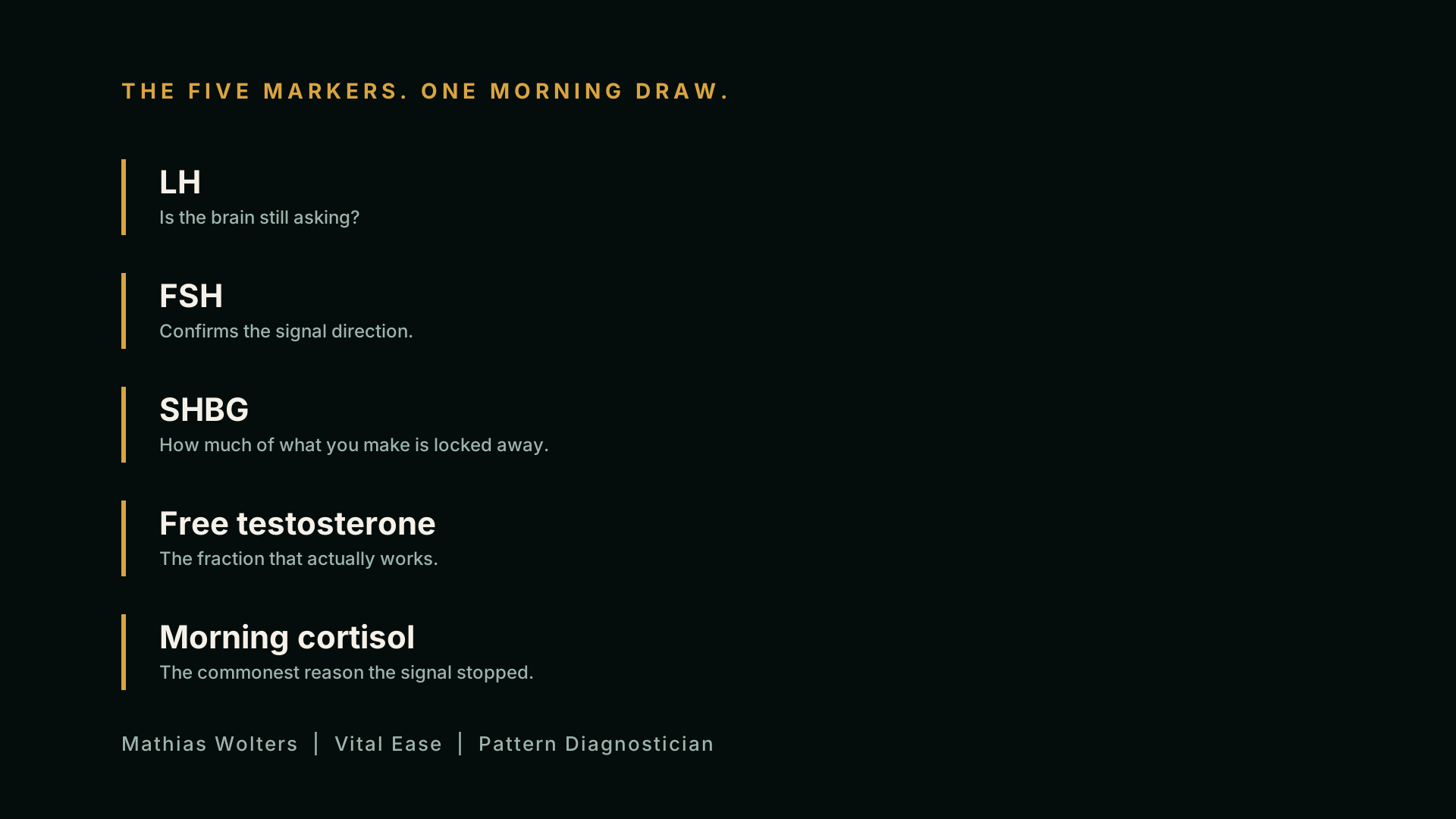
This is not a long or expensive panel. It is five numbers drawn fasted in the morning, and most of them are standard.
LH and FSH. These are the asking signals. If testosterone is low and LH is high, the brain is shouting and the body is not responding. Production problem. If testosterone is low and LH is also low, the brain has gone quiet. Suppression. That distinction changes everything that follows.
SHBG. Sex hormone binding globulin. It binds testosterone and takes it out of circulation. Your total testosterone can look acceptable while your free testosterone, the amount actually available, is low because SHBG is carrying most of it around in a locked case. A man with high SHBG and normal total testosterone is functionally low and nobody will catch it unless they look.
Free testosterone. The unbound fraction. The one that does the work.
Morning cortisol. Because the commonest reason the brain stops asking is stress. Cortisol suppresses the signal at the top of the loop. A founder running on high cortisol for three years has a brain that stopped placing the order, and the low testosterone is a downstream consequence of a system that decided survival mattered more than vitality.
Get those five. The picture is usually clear inside a single draw.
Why replacement without diagnosis creates the problem it solves
This is the part I wish more men understood before they started.
When you put testosterone in from outside, the brain reads the new level, sees it is adequate, and stops sending the signal. That is what the loop does. It self-regulates.
If the brain was already asking and the body was failing, replacement at least makes sense as a bridge while you find the production problem.
But if the brain had stopped asking because of stress, because of sleep debt, because of something suppressible, and you add testosterone from outside, the brain does not resume asking. It has no reason to. The external supply is doing the job.
Now stop the replacement. The brain has been off for months or years. The glands have been idle. The restart is slow, uncertain, and sometimes incomplete.
The fix created the dependency. The man who went on TRT to get his drive back now cannot come off it without losing what he got. And the thing that suppressed the axis in the first place was never addressed, so it is still running underneath the replacement, doing its damage in other places.
That is not treatment. That is wallpaper over a crack that is still moving.

What the tradition reads here
Same system, different lens.
There is a fire that sits low in you, underneath everything. It is the warmth that drives the engine. It is what gets you out of bed before the alarm, what holds your attention steady through a four hour build, what makes recovery feel like recovery instead of just less tired.
When that fire is strong, the drive is not effortful. It is not discipline. It is the natural state of a warm system with fuel underneath it.
When it weakens, everything above it cools. The drive goes first, because drive is heat. Then the recovery. Then the sleep. Then the lower back gets cold and stiff, and the feet are cold in bed, and the morning feels like dragging a heavy coat out of a dark room.
A man in that state does not need more fuel thrown in from outside. He needs the fire rebuilt underneath so it burns on its own again. And the first question is always: what put it out.
Usually it is the same list. Too much demand for too long. Sleep that stopped restoring. A system that shifted all its resources to surviving the day and turned off everything that was not immediately necessary.
Vitality is not immediately necessary. So it went first.
What rebuilds the axis without shutting it down
These are in order. The first two do the most, and they cost nothing.
Lower the cortisol. Not with a supplement. With the input that actually lowers it: a real evening. Screens off, warm food, nothing demanding after eight. The body will not resume the signal while it is still in survival mode. The off switch has to work before the on switch comes back.
Fix the sleep. Not the tracking. The sleep. Cool room, dark room, same time, no alcohol within three hours. Testosterone is manufactured overnight. A man sleeping five broken hours is not manufacturing. He is maintaining, barely.
Stop the SHBG climb. SHBG rises with age, with stress, with certain medications, and with low caloric intake. A founder who is intermittent fasting aggressively while under chronic stress is driving SHBG up while driving production down. More of what he makes gets locked away. Adequate calories, adequate fat, adequate protein. The system needs material, not restriction.
Train, but not like that. Moderate resistance work, legs included, two to three sessions a week. Heavy compound movements with real recovery between sessions. Not six days a week. Not fasted cardio at five in the morning. Overtraining suppresses the same axis you are trying to restart. The man doing the most is often doing the most damage.
Herbs, when the fire is genuinely low. There are herbs that warm the base without forcing anything, prescribed to what is actually there rather than to the complaint. That is clinical work, not a list, because the wrong warming herb on the wrong pattern makes it worse. This is the point where someone should read the whole picture and prescribe to it.
Before you close this
If your testosterone came back low and someone offered you replacement without asking why it was low, you were offered a solution to a question nobody asked.
Get the five markers. Find out which kind of low you are. If the brain stopped asking, find out what made it stop, and address that first. The axis can restart. It restarts faster than most men expect, when the thing sitting on top of it is removed.
Do not turn this into another protocol to grind at. Lower the cortisol. Fix the sleep. Give the system material and rest and time. That is enough for most men to feel the engine start again within a few months.
And if the fire underneath has genuinely gone cold, not suppressed but depleted, that is where the clinical work begins. Reading how far down it has gone, what else cooled with it, and what your reserve can carry while it comes back up. That is a different conversation, and it starts with someone looking at the whole picture.
The drive was never the thing you lost. It was the first thing to go when the fire went down. Relight the furnace. The house warms on its own.
Mathias
P.S. If you want to know which kind of low you are and what is sitting on the axis, that is exactly what the Sovereign Biological Audit reads. Panel, body, the whole picture, built around you. Details here: vitalease.co/sovereign-biological-audit
P.P.S. I made a short video walking through why the standard approach to fatigue and low drive misses the mechanism underneath. Worth ten minutes if this piece landed: https://www.youtube.com/watch?v=N2iWl9XCGiw